
End-to-end data flow: from unschedulable pod to bound node
This is the cross-cutting trace. Every other internals page picks one subsystem and goes deep;
this one follows a single datum — one pod’s worth of demand — across every component boundary
it crosses, from the moment a Pod lands in a managed cluster to the moment a kubelet registers
on a node BigFleet provisioned, and back around for the reclaim that releases it. It exists to
answer the onboarding question the per-subsystem pages assume you already have: where does each
fact live, who owns it, and what is the timing budget between the hops? Read
../architecture.md for the shape first; read
decision-engine.md and shard-hot-path.md after this
for the function-by-function interior of the one box (the shard cycle) this page treats as a unit.
The design rationale is the two papers — BigFleet and Fleet-Scale Kubernetes (vendored under
../papers/); the timing posture is ADR-0014
/ ADR-0018 / ADR-0020.
The complete system map
Before the step-by-step trace, here is the whole system at rest — every component, down to its
internal sub-components, and every relationship between them, on one canvas. The control plane
(the Raft coordinator and the state it owns) sits in the top band, deliberately off the hot path;
the data plane below it — clusters → operators → shards → providers → the machine pool — keeps
running autonomously even with the coordinator entirely down. Data-plane edges are solid grey;
control-plane edges (ReportShard, Raft replication, admin RPCs) are blue dashed. Two relationships
are worth tracing explicitly because they are easy to get wrong: every shard reports to the one
coordinator, but ReportShard is a shard-initiated pull — rebalance and topology-domain
assignment instructions ride back on the response and are acked on the next call, so there is no
coordinator→shard push channel; and pkg/shard never imports pkg/coordinator — the only coupling
is the off-hot-path coordclient, which is exactly what lets the data plane survive coordinator
failover.
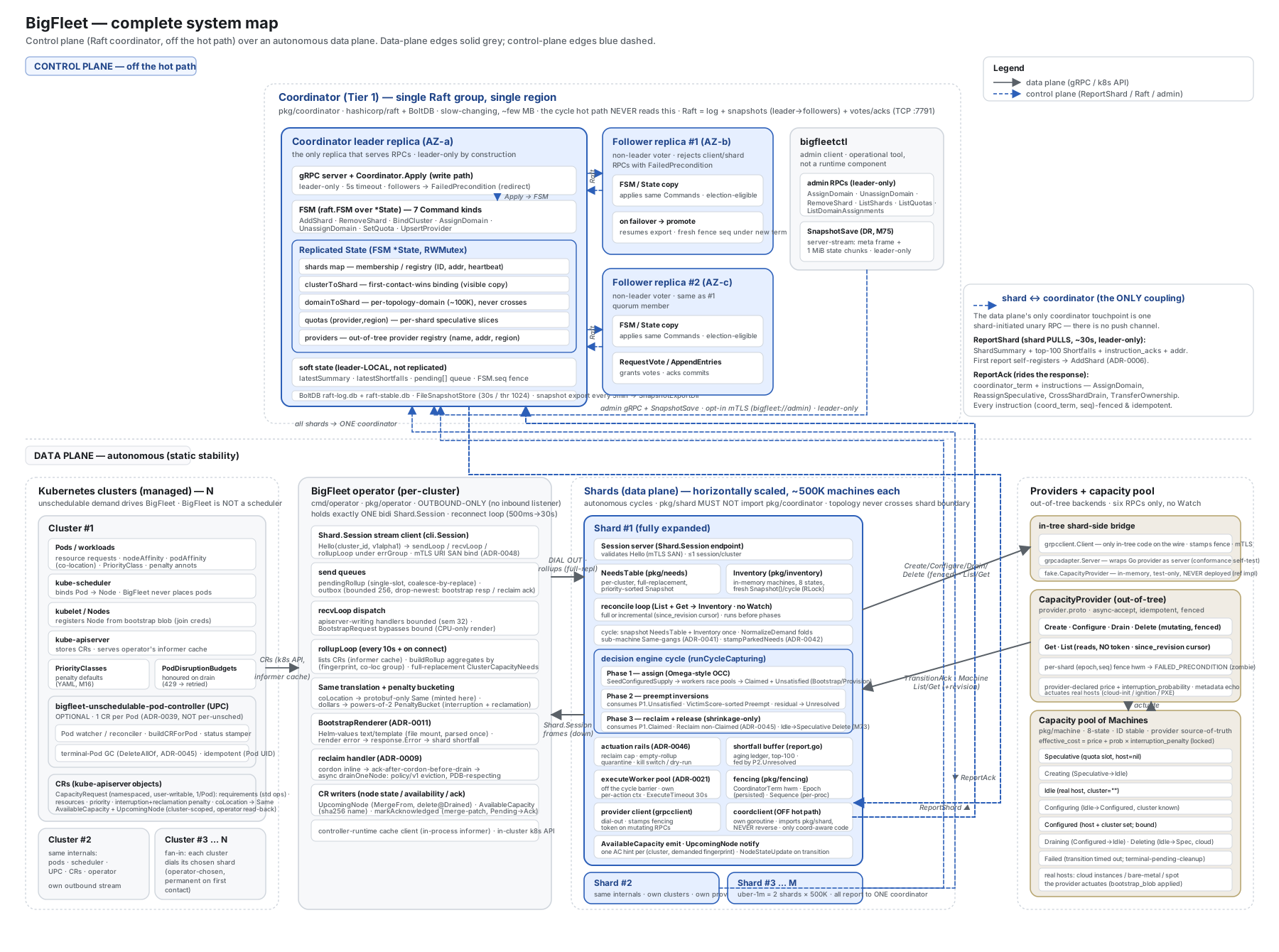
The rest of this page is the same picture in motion: one datum — a single pod’s worth of demand — moving through these components over time.
The whole chain, at altitude
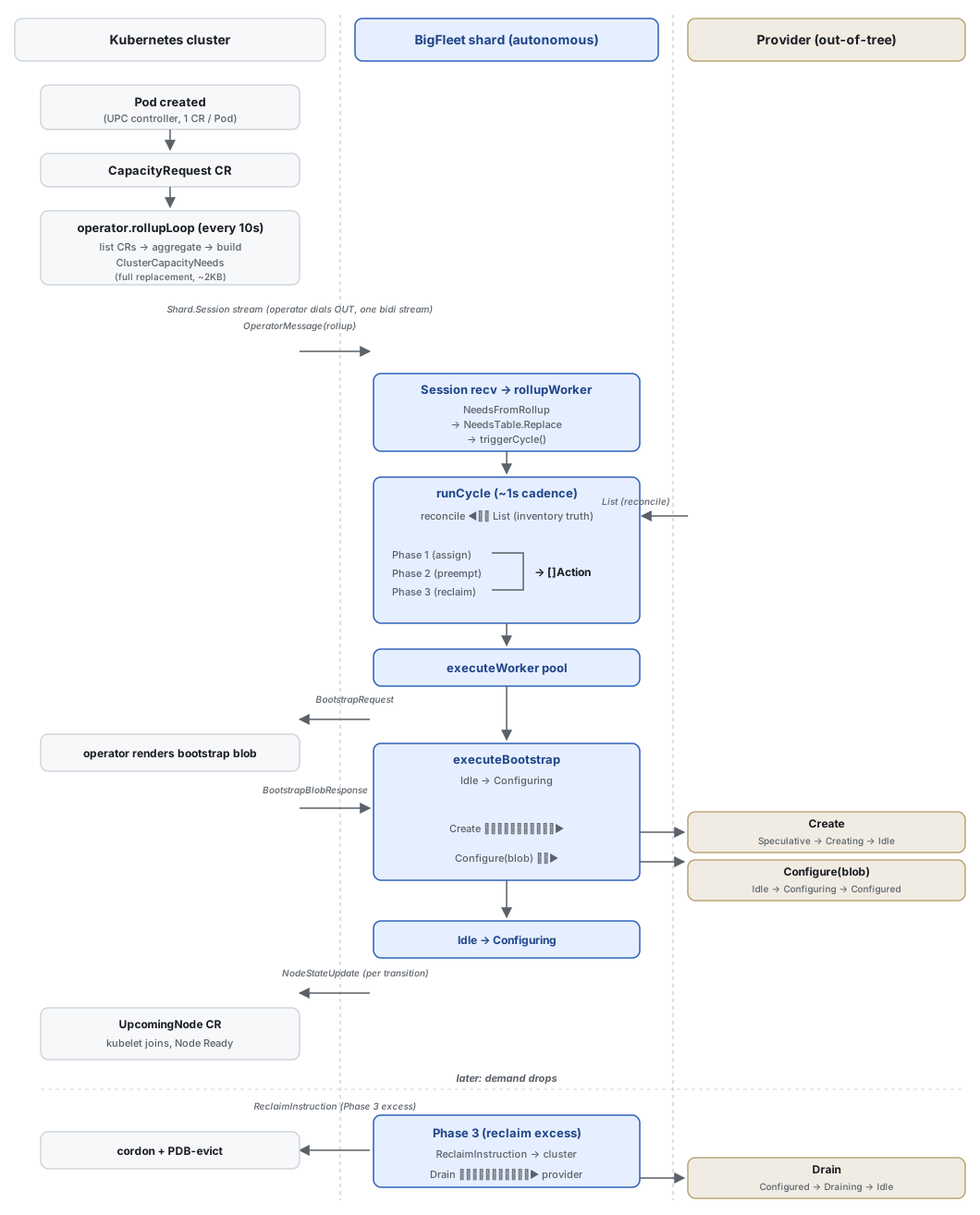
Three ownership boundaries, never crossed the wrong way:
- The operator dials out. There is no inbound listener on the cluster side. Every byte of
cluster↔shard traffic rides the one bidirectional
Shard.Sessionstream the operator opens (pkg/operator/stream.go:39,api/proto/.../shard.proto:22). The shard cannot call the operator; it pushes frames down the stream the operator is holding open. - The shard is autonomous. Nothing in this chain touches the coordinator.
pkg/sharddoes not importpkg/coordinator(guarded bypkg/shard/no_coordinator_dep_test.go); the cycle reconciles, decides, and actuates against provider + operator alone. Clusters keep running with the whole control plane down. - The provider is the only actuator. Six RPCs, all out-of-tree
(
api/proto/.../provider.proto:47). The shard never touches a cloud API directly.
The rest of this page walks each hop, naming the datum, the type, the package, and the timing point.
Hop 1 — Pod → CapacityRequest CR (one per Pod, not per unschedulable Pod)
Demand enters BigFleet’s world as a CapacityRequest CR in the managed cluster. The reference
producer is the optional bigfleet-unschedulable-pod-controller (pkg/controller/cr/controller.go),
which watches Pods and creates one CR per Pod, owner-referenced to the Pod so deleting the Pod
garbage-collects the CR (controller.go:1). The name is a historical misnomer:
ADR-0039 changed the controller
from “CR per Pod seen Unschedulable” to “CR per Pod, full stop.” The reason is asymmetric and
load-bearing: Phase 1 (Bootstrap) only needs the unmet fraction of demand and was correct on an
Unschedulable filter, but Phase 3 (Reclaim) needs total demand — with CRs undercounting
total demand ~6× (the #45–#48 cascade measured ~84% of bound Pods carrying no CR), Phase 3 saw a
permanent phantom surplus and reclaimed into it every cycle. One CR per running Pod is what makes
the roll-up the cluster’s complete desired state, which is what both phases read.
This controller is optional. Any source — an admission webhook, Kueue, a bespoke operator — can
write the CRs; BigFleet only consumes them (controller.go:14). Penalties are declared here, by
Pod annotation or per-PriorityClass default (controller.go:62): interruption-penalty and
reclamation-penalty, two distinct dollar values that survive all the way to victim scoring.
Where the datum lives: CapacityRequest CRs in the cluster apiserver. One per Pod. Spec
carries the Pod’s resource request, node-selector requirements (standard operators only — In,
NotIn, Exists, DoesNotExist), PriorityClass value, topology spread, an optional co-location
term, and the two raw penalties.
Hop 2 — CRs → ClusterCapacityNeeds roll-up (full replacement, aggregated)
The operator’s rollupLoop fires every RollupInterval (default 10 s,
pkg/operator/operator.go:137; one immediate fire on connect, rollup.go:35). Each tick:
- List every CR in the cluster (
rollup.go:121). - Aggregate by
(Profile fingerprint, co-location group)viabuildRollup(rollup.go:151). Under ADR-0027 each CR contributes one Pod’s worth of demand: its resource request is both the unit summed intoaggregate_resourcesand the atomicmin_unitthat must fit on one machine. No Pod count crosses the wire — machine count is the autoscaler’s output, never the cluster’s input (rollup.go:129,capacity.proto:60reserves the removedcountfield). This is why the wire message stays ~2 KB regardless of fleet size: a million identical Pods collapse to oneCapacityNeedwhoseaggregate_resourcesis their vector sum. - Translate co-location to
Same. A CR’s co-location term (the canonical projection of its source Pod’s requiredpodAffinity, ADR-0024) is canonicalised into a stable group key (coLocationGroup,rollup.go:199;canonicalLabelSelector,rollup.go:212). CRs with an equal term aggregate into one Need and the operator appends a protobuf-onlySamerequirement on the term’s topology key (withSameRequirement,rollup.go:258).Sameexists only on the wire — the CRD carries only standardcore/v1operators (requirementOperatorFromCore,rollup.go:331, maps exactly those four), and the operator is the only place aSamerequirement is ever minted, from the co-location term. CRs with different terms stay separate even when their profiles are identical, so independent gangs each get their own domain. - Bucket the penalties. Raw dollar values become powers-of-2
PenaltyBuckets here — the operator is the canonical place this happens (profileFromCapacityRequest,rollup.go:316; boundariescapacity.proto:136). Bucketing bounds the roll-up size when penalties are workload-specific; the cost-function error is dwarfed by the bucket resolution.
The output is one ClusterCapacityNeeds (capacity.proto:20): cluster_id, a timestamp, and the
aggregated []CapacityNeed. Every roll-up is a full replacement of the cluster’s desired state
(capacity.proto:5, paper §3.1). Withdrawal is implicit — a CR no longer present is simply absent
from the next roll-up. This is the single most important invariant of the demand path: the receiver
never diffs partial updates; it replaces wholesale.
After building, the operator marks the included Pending CRs Acknowledged — a one-way status
transition, written once per CR ever (markAcknowledged, rollup.go:413, via JSON merge-patch to
avoid resource-version conflicts under burst).
Timing point: a Pod that arrives just after a tick waits up to one full RollupInterval before
the shard sees its CR. The 10 s default is therefore a hard floor on internal binding latency —
ADR-0020 sizes the internal
SLO at rollupInterval + 5 s for exactly this reason and treats 10 s as a deliberate production
posture (10× fewer messages and aggregation passes than 1 s, invisible next to real-provider
create time).
Hop 3 — roll-up → shard NeedsTable, over the one stream
The operator enqueues the roll-up onto its send path. The send path has two queues with different
drop policies (pkg/operator/stream.go:87):
pendingRollup— a single-slotatomic.Pointer. Because roll-ups are full replacement, enqueuing a fresh one atomically replaces and drops any older pending one (enqueueRollup,stream.go:182). Coalesce-by-replace: the operator never queues two roll-ups behind a slow stream.outbox— a bounded channel (cap 256) for non-coalescing RPC responses (BootstrapBlobResponse,ReclaimAck). Drops newest with a metric when full, because those are responses to a shard request the shard will re-issue on timeout (enqueue,stream.go:195).
The session was opened by runOnce (stream.go:20): dial with mTLS if configured
(ADR-0048), send Hello with the cluster_id
(stream.go:45), then run three goroutines — sendLoop, recvLoop, rollupLoop — any one of
which returning aborts the others and triggers a reconnect with exponential backoff
(operator.go:164, nextBackoff).
On the shard side, Session (pkg/shard/session.go:36) validates the Hello: on an mTLS
transport the client certificate’s URI SAN must assert the claimed cluster_id, or the session is
terminated PermissionDenied (session.go:54) — otherwise Hello.cluster_id is a free-text
impersonation vector that could zero another cluster’s capacity with a forged full-replacement
roll-up. At most one session per cluster: a new connection replaces and closes the prior one
(installSession, session.go:147).
Inbound frames are routed by routeOperatorMessage (session.go:119). The split here is the
M44.4 Drop B fix: fast paths stay inline, slow paths go to a per-session worker. A roll-up is
the slow path (NeedsFromRollup decode + NeedsTable.Replace + cycle trigger), so it is handed to
rollupWorker via a buffer-1 channel (enqueueRollup, session.go:226) — if a queued roll-up is
already pending, the newer arrival drains and replaces it (full replacement again). Without this
split a slow roll-up blocked delivery of the BootstrapBlobResponses an in-flight executeBootstrap
was waiting on, pushing them past their deadline and marking machines Failed for an orchestration
timeout unrelated to the machines (session.go:80).
rollupWorker (session.go:250) decodes via conv.NeedsFromRollup. On a decode failure it
rejects the whole roll-up loudly and keeps the last-known-good demand (session.go:262) — same
posture as the provider-ingest gate. On success it calls ApplyRollup (shard.go:442), which
replaces the cluster’s NeedsTable slice and marks the ADR-0036
first-rollup gate, then triggerCycle() (session.go:280). ApplyRollup may instead quarantine
a full-replacement roll-up that would erase most of the cluster’s previously accepted demand
(ADR-0046 empty-roll-up guard, shard.go:444) — the
previous demand stays active until consecutive reports confirm the drop. Either way the
first-rollup gate clears: the operator did report.
Where the datum lives now: the shard’s in-memory NeedsTable, per cluster, priority-sorted, full-replacement. The cluster’s CRs are no longer consulted; the NeedsTable is the demand truth the engine walks.
Hop 4 — the shard cycle: reconcile, Phase 1/2/3, queue actions
triggerCycle (shard.go:603) coalesces onto a wakeup channel; Run (shard.go:487) fires a
cycle on that wakeup or on the CycleInterval ticker (default 10 s in code, but profiles run it at
~1 s under load; the cycle is the engine’s heartbeat). One cycle is runCycleCapturing
(shard.go:627):
- Reconcile inventory against the provider before deciding, so decisions run on a fresh view
(
shard.go:649).reconcile(pkg/shard/reconcile.go:29) callsprovider.List— full every cycle by default, or incremental via an opaquesince_revisioncursor for providers above the ADR-0004 threshold (the difference between the cycle SLO being achievable at 500K and not — reconcile was ~85% of the cycle).applyReconciledMachine(reconcile.go:116) merges each machine: a state-match fast path does nothing; a diverged state applies the provider’s view while preserving locally-knownAssigned*attribution; a genuinely new machine is inserted, rebuilding attribution from the provider-echoedshard_metadata(the M72 restart-recovery path). In-flight machines are skipped (isPending,shard.go:559) — the provider’sListlags an in-flight RPC and would overwrite the worker’s transitional state. - Snapshot inventory and demand under one consistent read (
shard.go:663), thenNormalizeDemandfolds sub-machineSame-Needs into atomic aggregates (ADR-0041) so all three phases reason over identical normalized demand. - Phase 1 — assign (
pkg/decision/phase1_assign.go:100). Walks the NeedsTable; for each Need, credits existing bound supply, then commits Idle machines (→Bootstrapactions) and Speculative machines (→Provisionactions) to fill the deficit, by effective cost. The accounting rule is ADR-0045: capacity counts for a cluster iff bound to it; the pre-pass credits Configured and Configuring machines, so a binding counts from the moment it is made, before the node exists — double-supply is impossible by construction. Runs as an Omega-style optimistic-concurrency scheduler (ADR-0029; seephase1-occ.md). The output’sClaimedset is the engine’s single supply attribution that Phase 3 consumes. - Phase 2 — preempt inversions (
pkg/decision/phase2_inversions.go:66). Walks Phase 1’sUnsatisfieddeficits, scores lower-priority Configured victims, emitsPreemptactions. It does not move the machine to the preemptor — it drains victims to Idle; next cycle’s Phase 1 reclaims them (phase2_inversions.go:38). - Phase 3 — reclaim excess (
pkg/decision/phase3_reclaim.go:77). Shrinkage-only: a Configured machine is excess iff Phase 1’sClaimedwalk left it unclaimed (phase3_reclaim.go:91). At steady demand nothing is unclaimed and Phase 3 emits nothing. It re-derives no keep-set of its own — sharing Phase 1’s single attribution is what removed the Bootstrap↔Reclaim oscillator class (phase3_reclaim.go:48). The same pass adds §8’s release half (M73 / ADR-0049): unclaimed Idle machines past theirCapacityTypehold getDeleteactions (phase3_reclaim.go:108). The ADR-0036 first-rollup gate applies to reclaim but not to Idle release — an Idle machine is bound to no cluster, so releasing it takes capacity from no one.
The cost and victim formulas are fixed, not pluggable (pkg/decision/cost.go:1):
effective_cost = price_per_hour + (interruption_probability × interruption_penalty)victim_score = priority_gap·w_pri + (1/drain)·w_drain + (1/interruption_penalty)·w_int + (1/reclamation_penalty)·w_recinterruption_probability is provider-declared only (provider.proto:116, Machine.interruption_probability)
— no cluster-side override. The two penalties are distinct: interruption_penalty (cost of
interrupting the workload; in effective_cost and victim scoring) versus reclamation_penalty
(operational value of the specific machine; in idle tiebreak, victim scoring, §8 release). Drain
grace is a locked table keyed on the priority gap (10 s / 30 s / 2 m / 10 m, cost.go:102); a
voluntary Phase 3 reclaim has no preemptor and gets the most generous 10 m tier (ReclaimGrace,
cost.go:122).
All three phases’ actions collapse into one queue (shard.go:777) — they compute on the same
snapshot so ordering between them is irrelevant. The actuation safety rails apply here, before
anything executes: the per-cluster reclaim blast-radius cap (shard.go:793), MaxActionsPerCycle
deferral (shard.go:808), the ActuationPaused kill switch and DryRun shadow mode
(shard.go:827/844), and a live-state re-check (actionStillApplicable, shard.go:583) plus a
per-machine in-flight dedup (pendingActions, shard.go:905) that together prevent a worker
dispatch whose target machine has already moved past the action’s required start state.
Hop 5 — execute: provider Create/Configure, blob over the stream
Actions enqueue onto a persistent worker pool (ADR-0021,
executeWorker, shard.go:525). Each worker gets a fresh context capped by ExecuteTimeout
(default 30 s) — independent of the cycle that produced it, so a slow operator handler delays a
binding instead of cancelling and dropping it. execute (pkg/shard/execute.go:45) dispatches by
kind; every outcome is classified and audited (classifyExecuteError, execute.go:114).
The hot path for the trace is executeBootstrap (execute.go:242), which turns an Idle machine
into a Configured one:
- Idle → Configuring, stamping the destination cluster, the assigned Need fingerprint, and the
gang group early (
execute.go:286) so Phase 1’s deficit math counts this in-flight machine as supply for its Need while the Configure is still running — without this stamp Phase 1 over-emits a second Bootstrap on a fresh machine next cycle (Drop G). - Pull a bootstrap blob. Either via the operator’s stream (production) or a
LocalBootstraphook (simulator).requestBootstrap(session.go:317) mints a request ID, sends aBootstrapRequestdown the stream, and blocks on the matchingBootstrapBlobResponseup toBootstrapTimeout. The operator renders the blob (kubelet user-data / ignition / PXE) and sends it back (stream.go:340dispatch →handleBootstrapRequest). The shard treats a non-empty responseerroras an unsatisfiable requirement (session.go:338,shard.proto:99). A blob-fetch timeout rolls the machine back to Idle for retry — notFailed— because the provider hasn’t been touched yet (handleBootstrapBlobErr,execute.go:94). provider.Configure(blob)(execute.go:339), carrying the cluster, the blob, the fencing token, and the assignment’s protection state as opaque store-and-echoshard_metadata— the only durable copy a restarted shard can rebuild attribution from (execute.go:352, M72).- Configuring → Configured, stamping
AssignedPriority+ both penalty dollars + fingerprint + group for Phase 2 victim scoring (execute.go:363). TheConfiguring → Idlerace (a parallel actor flipped the machine back) is detected and surfaced aserrProvisionRacedToIdlewith natural next-cycle recovery (execute.go:378,errProvisionRacedToIdledoc atexecute.go:17).
If no Idle machine was available, executeProvision (execute.go:181) runs first: Speculative →
Creating → Idle via provider.Create, then hands off to executeBootstrap. Create is where
provider-declared price / interruption_probability enter the inventory and the locked cost
formula — a garbage ack is treated as a provider error: Failed, loud, counted, never ingested
(ADR-0046, execute.go:216).
The six provider RPCs are the whole actuator surface (api/proto/.../provider.proto:47,
pkg/provider/provider.go:34): Create, Configure, Drain, Delete, Get, List. All four
mutating RPCs are asynchronous (return a TransitionAck, progress observed via List/Get),
idempotent on (machine_id, target_state), and fenced by (shard_id, shard_epoch, sequence_number)
so a zombie shard’s mutation is refused (provider.proto:14). There is no Watch —
reconciliation is List + Get, which is why hop 4 reconciles every cycle.
Hop 6 — node state back up the stream → UpcomingNode CR → Node Ready
Every transition on a cluster-bound machine emits a NodeStateUpdate up the stream. The hook is
in applyTransition (shard.go:1399): after the inventory write it calls notifyNodeState
(shard.go:1449), which looks up the bound cluster’s session and pushes a NodeStateUpdate carrying
the machine ID, the MachineState, provider ID, and — under ADR-0016
— the node identity (labels, allocatable resources, taints) the kubelet will register with, so
observers know the node’s shape before it joins (shard.go:1471, shard.proto:133). The binding is
captured before the mutation runs (prevCluster, shard.go:1420) so the terminal
Draining → Idle update — which clears Machine.Cluster — still routes to the cluster that owned
the machine.
NodeStateUpdate is a coalescing frame: supersedes_key = "node:<machine_id>" (session.go:404)
lets the shard’s outbox drop a stale queued frame when a newer one for the same machine arrives.
On the operator side, recvLoop runs these through a coalescer (stream.go:151): rapid
Idle → Configuring → Configured sequences for one machine collapse to a single apiserver write of
the terminal state, with a bounded dispatch semaphore (M44.4 Drop B — unbounded fan-out contended
on controller-runtime’s cache locks and blew the handler p99).
handleNodeStateUpdate (pkg/operator/upcoming.go:46) upserts an UpcomingNode CR, mapping each
MachineState to a phase (upcomingNodePhase, upcoming.go:401):
| MachineState | UpcomingNode phase |
|---|---|
| Speculative / Creating | Provisioning |
| Idle | Launched |
| Configuring | Registered |
| Configured | Ready |
| Draining | Draining |
| Failed | Failed |
(Drained is derived: a Launched update following a Draining phase, upcoming.go:141.) The
upsert uses MergeFrom patches rather than Update to dodge the ~26% resource-version conflict
rate under burst (upcoming.go:120), with RetryOnConflict as a backstop (upcoming.go:70) — a
dropped phase write was the dominant tail-latency driver in the scale runs because the shard does
not spontaneously re-emit. So a kubectl describe upcomingnode is the user’s window into the
provisioning a shard is doing on their behalf; the actual kubelet join is the cluster’s own
business (the blob the operator rendered in hop 5 carries the join credentials).
Where the datum lives now: an UpcomingNode CR per machine, status tracking the machine through
its states, plus — once the kubelet registers — a real Node. The Pod the chain started from binds
onto that Node by the cluster’s own kube-scheduler. BigFleet is not a scheduler; it never placed
the Pod, only made a Node it could land on.
Timing point: the internal binding latency BigFleet is accountable for is roll-up-observation
→ Configured. observeRolledUpDemand stamps first-seen time per (cluster, fingerprint) on roll-up
ingest (pkg/shard/provisioning_latency.go:15); observeProvisioningLatency samples the histogram
at the Configuring → Configured transition and deletes the stamp (provisioning_latency.go:58).
The user-facing latency is this internal number plus provider capacity-create time, which the
fake provider contributes zero of and which is measured outside this repo
(ADR-0018 /
ADR-0014). Cycle wall-clock is a
tracked perf envelope (cycle p99 ≤ rollupInterval/2), not the release gate — a 1 s cycle
inside a 10 s roll-up window is invisible next to a real cloud’s minutes-long Create.
Re-converge, and the reclaim half
Once the machine is Configured, the loop closes. Next roll-up still names the demand (the Pod still
has its CR), Phase 1’s pre-pass credits the now-Configured machine as supply, the deficit is zero,
and the engine emits nothing for that Need. Steady state is quiet — Phase 3 emits nothing because
Phase 1’s Claimed set covers every Configured machine.
When demand drops — the Pod is deleted, its owner-referenced CR is garbage-collected, the next full-replacement roll-up simply omits it — the chain runs in reverse:
- Phase 3 finds a Configured machine no longer in Phase 1’s
Claimedset (bound capacity now exceeds demand) and emits aReclaimaction with the 10 m voluntary grace (phase3_reclaim.go:94). executeDrain(execute.go:405) handles bothReclaim(Phase 3) andPreempt(Phase 2). It notifies the operator first via aReclaimInstructiondown the stream (sendReclaimInstruction,session.go:367) carrying the node names, the grace period, and the preemptor priority (0 for a voluntary reclaim, telemetry-only), so the cordon + PDB-respecting eviction runs ahead of the provider drain.- The operator drains (
handleReclaimInstruction,pkg/operator/reclaim.go:33): cordon each node, walk theUpcomingNodetoDraining, ack after cordon but before drain completes — the shard’s reclamation accounting is the cordon, not the drain, and drain can take minutes per pod (reclaim.go:52). Then it evicts non-DaemonSet pods through the policy/v1 eviction subresource so PodDisruptionBudgets are honoured up to the grace deadline (ADR-0009,evictPod,reclaim.go:221; 429-on-PDB is retried, not failed,reclaim.go:201). On completion theUpcomingNodewalks toDrainedand is deleted to keep the apiserver working-set from growing through soak (upcoming.go:157). provider.Drainmoves Configured → Draining → Idle (execute.go:436), clearing the cluster binding and allAssigned*attribution on the post-Drain transition (execute.go:448). The provider clears itsshard_metadataecho with the binding (provider.proto:179), so a restarted shard cannot resurrect a dead workload’s attribution onto a fresh assignment.- The freed Idle machine feeds the next cycle’s Phase 1 (if there is residual demand) or, past its
CapacityTypehold, gets a Phase 3Deleteback to Speculative (executeDelete,execute.go:475).
Preempt rides the exact same executeDrain path; the only differences are the
priority-gap-scaled grace (DrainGrace, cost.go:102) and a non-zero PreemptorPriority the
operator surfaces in events. The victim becomes Idle; the higher-priority Need that triggered the
preemption claims it next cycle in Phase 1.
What this trace does not cross
- The coordinator. Nothing above touched
pkg/coordinator. Cluster→shard binding, domain→shard assignment, and quota live there, but they are not on this hot path — the shard runs the whole demand→bind→reclaim loop autonomously. Seecoordinator-raft.mdandstatic-stability.md. - A shard boundary. A
Same-rack request that cannot be satisfied within one shard becomes a shortfall, never a cross-shard resolution (architecture.md “Wire formats and protocol invariants”). Shortfall has no standalone package: the buffer/aging live inpkg/shard(recordShortfalls,shard.go), the deficit is derived inpkg/decisionas the residual of Phase 1 → Phase 2 (phase2_inversions.go:247). - A scheduler. BigFleet never placed the Pod. It made a Node; the cluster’s kube-scheduler did
the rest. “Satisfied-but-stuck” (the cluster’s scheduler can’t pack its Pods onto bound capacity)
is explicitly the cluster’s problem, not the engine’s (
phase1_assign.go:78).
If any claim here drifts from the code, the code citation is the anchor — fix the page or the code
and note it, per the source-of-truth ordering in README.md and
../index.md. For the interior of the one box this page treated as a unit,
continue to decision-engine.md; for the concurrency model that runs it,
shard-hot-path.md.