
The `CapacityProvider` protocol and client
The provider boundary is the only place BigFleet touches real money and real machines. Everything upstream of it — the needs table, the decision engine, the shard’s inventory — reasons over an in-memory model; the CapacityProvider is what turns a decision to provision into an actual host, and a decision to reclaim into an actual drain. This doc is about the in-tree half of that boundary: the Go interface the shard programs against (pkg/provider), the dial-out gRPC client that fences and converts (pkg/provider/grpcclient), the server-side adapter the conformance suite and tests use (pkg/provider/grpcadapter), the in-memory fake that stands in for a real provider in every test (pkg/provider/fake), and the engine-side reconcile loop that observes machine state through List + Get rather than a Watch. The wire-level field semantics and round-trip invariants are in wire-protocols.md §provider.proto; the operator-facing how-to-build-one is in provider-author-guide.md. This doc covers the mechanics and the why, and does not repeat either.
The two interfaces, and why there are two
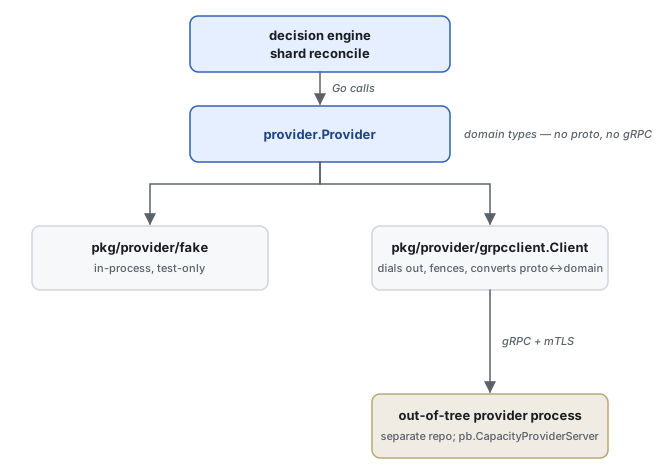
There is a proto service (bigfleet.v1alpha1.CapacityProvider, api/proto/bigfleet/v1alpha1/provider.proto:47-54) and a Go interface (provider.Provider, pkg/provider/provider.go:34-60). They describe the same six RPCs but are deliberately not the same type. The Go interface uses domain types (pkg/machine.Machine, machine.ID, typed GracePeriod) where the proto uses generated structs and map<string,string>. The package doc states the reason (pkg/provider/provider.go:5-13): the shard’s hot path runs against the Go interface and must not pay proto-runtime overhead per inventory entry, and an in-process fake must be writable without standing up gRPC. The proto↔domain conversion happens once, at the edge, in the gRPC client and adapter — never on the hot path.
This split is what makes the fake possible. The fake (pkg/provider/fake) implements provider.Provider directly, in process, with no gRPC at all — the decision engine, the shard, and the closed-loop simulator all drive it as a plain Go object. The same split is what makes the gRPC client (pkg/provider/grpcclient) the only in-tree code that talks to a real provider over the wire.
Six RPCs, no Watch — reconcile is List + Get
Create, Configure, Drain, Delete, Get, List. That is the entire surface (provider.proto:47-54, mirrored at provider.go:34-60). The four lifecycle RPCs are asynchronous — each returns a TransitionAck immediately and the real transition is observed later — and idempotent on (machine_id, target_state) via operation_id reuse. The two read RPCs are how the shard learns what actually happened.
There is no Watch, and the absence is a design decision, not an omission (provider.proto:9-11, plan §10.6). A Watch would make every shard hold a streaming subscription to its provider, re-introducing exactly the staleness-vs-liveness, reconnect-ordering, and missed-event problems that a poll-based List + Get sidesteps. The shard already runs a decision cycle on a timer; folding state observation into that same cycle as a List keeps the provider stateless about who is watching and keeps the shard’s correctness independent of stream health. The cost is poll latency, which ADR-0004’s incremental List makes cheap enough to ignore at scale.
The reconcile loop lives in pkg/shard/reconcile.go. reconcile (reconcile.go:29-34) picks one of two paths on Config.IncrementalReconcile:
- Full (default, correct against any provider).
reconcileFull(reconcile.go:39-62) issues an unfilteredProvider.List, applies every returned machine, then walks the local inventory snapshot to find machines the provider no longer reports and removes them. Linear in inventory size. - Incremental (opt-in, conformance-gated).
reconcileIncremental(reconcile.go:69-81) passes the savedSinceRevisioncursor, applies only the deltas, and advances the cursor fromresp.Revision. O(deltas) per cycle.
Get (the provider RPC) is the per-machine read used off the reconcile path — e.g. confirming a single machine’s state during action execution. Note that within reconcile.go and execute.go the frequent s.inv.Get calls are reads of the shard’s local inventory, not provider RPCs; the provider Get is the targeted “what does the source of truth say about this one machine” call. The bulk observation channel is List.
since_revision: opt-in, deltas only, and why the cursor is opaque (ADR-0004)
Pre-M11.22 reconcile issued a full List every cycle and processed the whole result. At 500K machines that was ~87% of per-cycle wall-clock (ADR-0004 Context). The fix was already on the wire — ListFilter.since_revision and MachineList.revision exist from v1alpha1 — but nothing honoured it. ADR-0004 added: a fake that honours the cursor, a shard path that uses it, and an explicit decision to defer tombstones.
The cursor is opaque bytes precisely so each provider chooses its own encoding without a wire change. The fake encodes it as a decimal of its internal mutation counter (fake.go:565-617): a cold-start (empty cursor) full-scans the map; a delta-List binary-searches an append-only revLog for the first entry past the cursor, dedups IDs, and emits current state — O(k + uniqueIDs) instead of O(N) (fake.go:43-56, 587-616). A malformed cursor is treated as cold-start (fake.go:624-633), defensive against a real provider’s encoding drift.
Two consequences worth internalising:
- The removal gap is real and deliberate. A delta
Listonly contains machines that exist; the proto has no tombstone field, soreconcileIncrementalskips the removal walk (reconcile.go:64-68). This is safe for any provider whoseDeletewalks a machine back toSpeculative(it stays in the inventory, state-changed) but unsafe for one that genuinely removes records. That is whyIncrementalReconciledefaults off and is documented as something the operator must verify their provider supports. The tombstone wire extension is owed to a future ADR, to be designed against a real removal use-case rather than pre-emptively (ADR-0004 Decision/Consequences). - The cursor is process-state, never persisted (
reconcile.go:79, ADR-0004). A shard restart loses it; the next reconcile is a cold-start fullList. This is the data-plane static-stability story: a restarted shard re-bootstraps inventory from scratch and converges, exactly as it would after a crash or rolling deploy — no coordinator round-trip, no durable shard state to corrupt.
The dial-out client (pkg/provider/grpcclient)
grpcclient.Client is the shard-side adapter: it implements provider.Provider over the proto service (grpcclient.go:54-59, compile-checked at :239). It is the only in-tree code that speaks to a real, out-of-tree provider (grpcclient.go:5-6). New dials lazily — gRPC connects on first call — and tlsCfg selects the transport per ADR-0048: zero value is plaintext (the legacy trust-the-network default), fully-set is mTLS with the shard presenting a cert whose URI SAN is bigfleet://shard/<ShardID> for the provider to authorize against (grpcclient.go:61-89).
Three things the client does that matter:
It stamps the fencing token; the shard never does. The Identity injected at construction (grpcclient.go:43-52) carries the shard’s stable ID, its persisted restart Epoch, and a per-process Sequence. Every mutating call (Create/Configure/Drain/Delete) sets shard_id, shard_epoch, and a freshly-minted sequence_number from this identity (grpcclient.go:98-148). The provider.Fence field on the Go request structs is server-side only — the shard leaves it zero; the client populates the wire fields itself (provider.go:77-90). Get and List carry no token (grpcclient.go:150-192) — reads don’t fence.
A fresh sequence number per call attempt makes transport retries safe. c.id.Seq.Next() is called once per RPC attempt, so a gRPC-level retry mints a new sequence and is never rejected as a replay (grpcclient.go:9-11, 100-102). Idempotency — the property that a retried Create doesn’t double-provision — is the provider’s job, keyed on (machine_id, target_state) via operation_id, never on the token.
It re-attaches the sentinel errors the shard matches on. mapStatusErr (grpcclient.go:215-226) is the inverse of the adapter’s mapErr: it wraps codes.NotFound→ErrNotFound, codes.Unimplemented→ErrNotSupported, and codes.FailedPrecondition→ErrFenced, while keeping the original gRPC status in the error chain (so status.FromError still unwraps and the shard’s message-reading classifier sees the provider’s verbatim text). FAILED_PRECONDITION is reserved on this service for fencing rejections (provider.proto:32-34), which is what lets the shard treat a fenced mutation as a zombie-shard incident (ErrFenced, “do not blind-retry”, provider.go:69-75) rather than a retryable failure.
Default per-call deadlines apply only when the caller’s context has none (grpcclient.go:38-41, 228-236): 30s for lifecycle and Get, 2 minutes for List. The asymmetry is correct — lifecycle RPCs are async-accept so a short deadline bounds only the acknowledgement, not the (possibly hours-long) transition, while List scales with inventory and needs room.
The server-side adapter (pkg/provider/grpcadapter)
grpcadapter.Server wraps a Go provider.Provider as a pb.CapacityProviderServer (grpcadapter.go:22-34). Production out-of-tree providers implement pb.CapacityProviderServer directly and never need this; the adapter exists so the in-tree fake can be exposed over a real gRPC port — for tests, and crucially for the conformance suite’s self-test (grpcadapter.go:1-6). It does the proto→domain conversion on the way in and mapErr (the inverse of the client’s mapStatusErr) on the way out (grpcadapter.go:142-156), with FAILED_PRECONDITION reserved for ErrFenced and everything unmapped — including invalid state transitions — collapsing to Internal.
The validation boundary (ADR-0005)
The single most important architectural fact about this layer: the provider boundary is the validation point, and reconcile trusts domain types. ADR-0005 removed a belt-and-braces re-validation that round-tripped every reconciled machine through MachineToProto + MachineFromProto “to exercise the validation paths.” At 500K inventory with 1000 deltas/cycle that round-trip was ~70ms of pure redundancy (ADR-0005 Context).
The responsibility split is now explicit (ADR-0005 Decision):
pkg/provider/fakevalidates by construction — it buildsmachine.Machinevalues from typed inputs, so invalid combinations can’t be written.pkg/provider/grpcadapter(and the client’sconv.MachineFromProto) validate at the proto→domain conversion, once per RPC response, not once per machine.pkg/shard/reconcileassumes valid input and applies it;inventory.Apply’s ownmachine.Invariant+machine.CheckTransitionchecks (pkg/inventory/inventory.go:89-103) are the backstop for “bad data slipped through anyway.”
There is one nuance the doc-as-of-ADR-0005 didn’t anticipate, captured in the current code: applyReconciledMachine does screen records that take a slow path through machine.Invariant before they touch inventory (reconcile.go:100-115, 136-138), because the production-readiness audit found nothing bounding provider-declared price / interruption_probability on this path — and interruption_probability feeds the cost formula directly. The state-match fast path (reconcile.go:132-135) is not screened because it ingests nothing. So “the boundary validates” is the rule; the reconcile-side Invariant screen is the narrow safety net for cost-formula inputs a misbehaving provider could otherwise poison.
applyReconciledMachine also encodes two non-obvious behaviours:
- It skips in-flight machines (
reconcile.go:129-131): while a worker is driving a machine through a provider RPC, the localapplyTransition-ed state is authoritative, because the provider’sListview lags the in-flight RPC and would otherwise overwriteConfiguringback toIdleand break the post-Configuretransition. - On a genuinely-new record it decodes the provider-echoed
shard_metadatato recover assignment state (reconcile.go:159-164) — the M72 restart-rebuild path, where the echo is the only durable copy of the priority/penalty/fingerprint that Phase 2 victim scoring needs. The map itself is never carried onto the hot path; it is decoded and dropped (reconcile.go:145,163).
interruption_probability is provider-declared only
Machine.interruption_probability is the provider’s hourly forecast (for SPECULATIVE) or observation (for real machines), [0,1], with no cluster-side override and no max-merge (provider.proto:115-118). This is a hard rule, not a default. It is one of the two inputs to the fixed cost formula effective_cost = price + interruption_probability × interruption_penalty; the formula is not pluggable and the probability is not configurable. The conformance suite enforces the bound (TestConformance_CostFieldBounds, conformance_test.go:397-418): price_per_hour must be non-negative and non-NaN, interruption_probability must be in [0,1] and non-NaN — a provider that emits garbage here fails compatibility, because garbage here corrupts every cost comparison the engine makes.
The fake (pkg/provider/fake) — test-only, never deployed
The fake is an in-memory CapacityProvider used as a fixture by the decision engine, the shard, and the simulator (fake.go:1-8). It is not a deployable artifact: no Helm chart, no published image, no gRPC surface of its own (it gets one only when wrapped by grpcadapter for the self-test). Real providers live in separate repositories — the fake exists solely to exercise the engine without a real provider. The repo ships zero in-tree real providers by rule (next section).
What the fake models faithfully, and why it has to:
- The full eight-state lifecycle through one
applyTransition(fake.go:491-544), which handles fencing, idempotent retry, failure injection, transition-validity (machine.CanTransition), and the instant-vs-staged mode. Each lifecycle method is a thin wrapper supplying a post-effect (fake.go:414-460):Createsets the host only once the record reachesIdle;Configurerecords the cluster and stores theshard_metadataverbatim;Drainclears the binding, theAssigned*fields, and the metadata together (it is per-assignment state, not per-machine);Deleteclears the host only atSpeculative. - The fencing high-water-mark contract (
fake.go:462-489).checkFenceruns before the not-found check and before idempotent-retry short-circuiting (fake.go:494-500), per the proto contract: a zombie’s request must not be applied, must not be answered with a cachedoperation_id, and must not learn whether the machine exists. A passing token advances the mark even if the operation then fails. A zero token (in-process harness construction) bypasses fencing entirely. The fake enforces this because it is what the conformance self-test runs against — it has to model the contract real providers are held to (fake.go:65-71). store-and-echo, never interpretforshard_metadata. The fake is the conformance reference, so it deliberately does not decode the well-known metadata keys into theAssigned*fields (fake.go:422-432): copying the verbatim map, unknown keys included, is the whole obligation. Decoding is the shard’s job at reconcile ingest, not the provider’s.
InstantTransitions (Options, fake.go:127-139) is the mode most tests use: a lifecycle call lands the machine in its stable target immediately rather than parking it in the transitional state. The two staging overrides (ConfigureStaged, CreateStaged) exist for the closed-loop sim’s dwell models — they keep a machine in Configuring/Creating across cycles so the engine observes the in-flight runway the over-acquire investigations (ADR-0051 / M77g) turned on, with CompleteStaged (fake.go:351-371) driving the staged transition to completion when the sim’s dwell budget elapses. The fake also exposes test hooks the wire contract has no analogue for: FailNext (inject a one-shot RPC error), FailMachine (force Failed, modelling a discovered spot reclaim), and RemoveMachine (hard host loss the next List surfaces as an absence).
Out-of-tree by rule, and why
The repo ships the contract (provider.proto), the dial-out client (grpcclient), the adapter (grpcadapter), and the test fake — and no real providers. This is a hard rule (provider.go:14-15, fake.go:3-7). The reason is stated tersely in the package doc and worth stating in full: Kubernetes spent years undoing in-tree cloud providers (CCM) and in-tree storage drivers (CSI), because bundling provider code into the core binary couples every provider’s release cadence, dependency tree, and security surface to the core’s. BigFleet does not repeat that. A real provider is a separate process in a separate repo, implementing pb.CapacityProviderServer, reached only over gRPC through grpcclient.
The dev/laptop path is the one exception that proves the rule: with --provider-addr unset, cmd/bigfleet shard constructs the in-process fake and all the --seed-* / --failure-rate-per-sec knobs poke it directly (cmd/bigfleet/shard.go:655-679). Those knobs are only available against the fake — combining them with --provider-addr is a hard error (shard.go:666-668) — because they exist for kind/scaletest, never for a real fleet. With --provider-addr set, the shard dials the real provider via grpcclient.New(addr, Identity{ShardID, Epoch}, tlsCfg) and fences every mutating call with the same persisted epoch it advertises everywhere else (shard.go:669-675).
The conformance suite is the compatibility gate
test/conformance/ is the suite an out-of-tree provider runs to claim BigFleet compatibility — “a passing run = the provider is BigFleet-compatible” (conformance_test.go:1-18). It is built behind the conformance tag, takes the provider’s gRPC address via -target or BIGFLEET_PROVIDER_TARGET, seeds a handful of speculative slots, and walks the contract. It asserts, among others (conformance_test.go, fencing_test.go, metadata_test.go):
- Full lifecycle
Speculative → Idle → Configured → Idle → Speculative(TestConformance_FullLifecycle). - Idempotency of each of
Create/Configure/Drain/Delete(*Idempotent). - Read semantics:
Get/Deleteon unknown machines,Liststate-filtering andMaxResults, label and cost-field shape, transitional-state observability, and revision advancement (TestConformance_ListRevisionAdvances— opt-in: a below-threshold provider may return a constant revision, but a provider that does advance it must change it after a mutation,conformance_test.go:420-452). - Invalid transitions rejected (
DrainOnSpeculative,DeleteOnConfigured). - Drain grace timeout behaviour (
TestConformance_DrainGraceTimeout). - The five fencing properties (
fencing_test.go): unknown shard accepted and establishes the mark; stale epoch rejected; stale/equal sequence rejected; a new epoch resets the sequence space; reads unaffected by the mutation-side high-water mark. Each test uses a run-uniqueshard_idso repeated runs against a long-lived provider don’t collide (fencing_test.go:26-29). shard_metadatastore-and-echo (metadata_test.go): echoed verbatim onGet/List, cleared with the binding onDrain, and unknown keys preserved byte-for-byte.
The suite keeps itself honest with a self-test (TestConformance_SelfTest_OnFake, selftest_test.go): it stands the in-tree fake up behind grpcadapter on a random localhost port and runs the whole conformance suite against it as a child go test process (selftest_test.go:31-103). This proves the suite is internally consistent and that the fake genuinely satisfies the contract real providers are graded against — the fake is the conformance reference precisely because it is the thing the conformance suite continuously validates itself with. Run it via make conformance TARGET=host:port.
What an out-of-tree provider must get right (the short version)
For the full author guide see provider-author-guide.md. From the in-tree machinery’s perspective, the load-bearing contracts are: lifecycle RPCs accept asynchronously and are idempotent on (machine_id, target_state); reconciliation is List + Get, with since_revision optional and conformance-gated; interruption_probability and price_per_hour are provider-declared and must satisfy the cost-field bounds; fencing is enforced on the four mutating RPCs with FAILED_PRECONDITION reserved for it; and shard_metadata is stored, echoed, and cleared-with-the-binding but never interpreted. Get those right and the dial-out client, the reconcile loop, and the restart-rebuild path all work unchanged.