
The machine state machine
This is the code-level deep-dive on pkg/machine — the domain Machine record, its
state machine, the stable ID that survives the whole lifecycle, and the Profile
aggregation type. It bridges the high-level table in concepts.md
(“Machine state machine”) and paper §5 (“Shard architecture / Machine model”) down to the
source. Read those two first for the what; this doc is the why and the exact contract.
If you only need the legal transitions at a glance, jump to The transition table.
pkg/machine is the bottom of the shard’s dependency stack: pkg/inventory, pkg/decision,
pkg/conv, and pkg/provider/fake all build on these types. It imports nothing from BigFleet —
only stdlib (errors, fmt, math, and strconv in shardmetadata.go). That isolation is
deliberate (see Why plain Go structs).
The eight states
State is a uint8 (pkg/machine/machine.go:29). There are eight values, but the
operative set the engine reasons about is seven — the eighth, StateUnspecified, is the
zero value and is never a legal resting state for a real machine. The project’s shorthand
(“3 stable + 4 transitional + Failed” = 7) counts the seven real states; concepts.md and the
State doc comment (machine.go:28) say “eight” because they count StateUnspecified itself.
The code adds StateUnspecified = iota as the guard zero value so that a
default-constructed Machine{} fails Invariant() (pkg/machine/machine.go:341) rather than
masquerading as a valid Speculative slot.
State const | Name | Host | Cluster | Class | Meaning |
|---|---|---|---|---|---|
StateUnspecified | — | — | — | zero/guard | default value; never legal at rest |
StateSpeculative | Speculative | nil | "" | stable | quota slot, not yet provisioned |
StateCreating | Creating | nil | "" | transitional | provider running Create (Speculative → Idle) |
StateIdle | Idle | set | "" | stable | real hardware, no cluster binding |
StateConfiguring | Configuring | set | maybe | transitional | provider running Configure (Idle → Configured) |
StateConfigured | Configured | set | set | stable | real hardware, joined to a cluster, serving |
StateDraining | Draining | set | set | transitional | provider running Drain (Configured → Idle) |
StateDeleting | Deleting | set | "" | transitional | provider running Delete (Idle → Speculative) — cloud only |
StateFailed | Failed | — | — | terminal-pending-cleanup | last transition timed out; LastError set |
State.String() (pkg/machine/machine.go:44) is the canonical name source; an out-of-range
value renders as State(N), so a corrupted byte is visible in logs rather than blank.
Stable vs transitional — and why it matters
State.IsStable() (pkg/machine/machine.go:69) returns true for exactly
{Speculative, Idle, Configured}. This is the load-bearing distinction, not a label:
the decision engine only allocates from, and only emits transitions that begin in, a stable
state. A machine mid-Configure is neither claimable as free capacity nor a valid preemption
victim until it settles. Failed is not stable for the engine’s purposes — IsStable()
returns false for it — even though it is a resting state; a failed machine is inventory awaiting
cleanup, never a candidate. machine_test.go:71 pins the exact membership of both sets.
The three stable states are distinguished by the (Host, Cluster) cross-product, and the paper
states the one impossible corner explicitly (§5): host=nil, cluster≠0 cannot occur. Invariant()
enforces the full grid (pkg/machine/machine.go:315):
Speculative,Creating→ host must be empty, cluster must be empty (a quota slot has no hardware).Idle,Configuring,Deleting→ host must be set; cluster may be set duringConfiguringbecause the destination is already known.Configured,Draining→ host and cluster must be set.Failed→ no structural grid; butLastErrormust be non-empty (a Failed machine with no diagnosis is itself an invariant violation —machine.go:338).
The transition table
Idle is the hub. Every cross-cluster transfer routes through it — there is no direct
Configured(A) → Configured(B). The paper (§5) states the canonical path:
Configured → Drain → Idle → Bootstrap → Configured(new cluster).
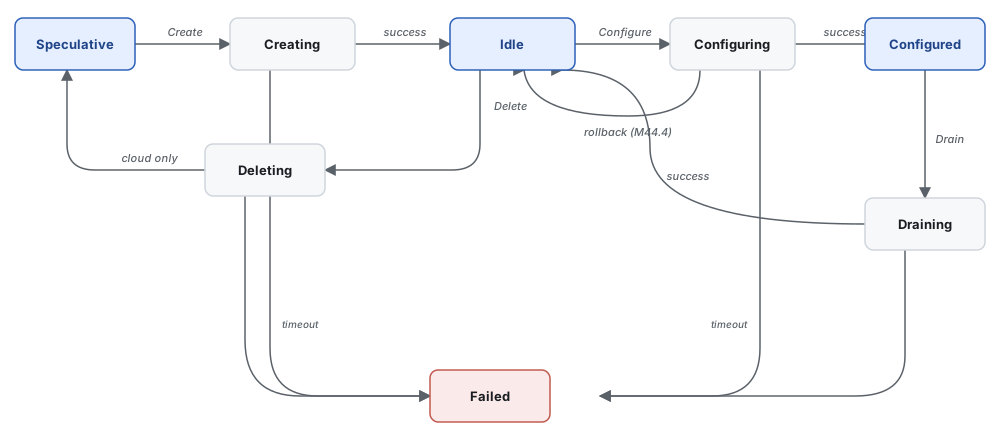
The legal edges are encoded as a static map, validTransitions (pkg/machine/machine.go:235):
| From | Allowed to |
|---|---|
Speculative | Creating |
Creating | Idle, Failed |
Idle | Configuring, Deleting |
Configuring | Configured, Failed, Idle (rollback) |
Configured | Draining |
Draining | Idle, Failed |
Deleting | Speculative, Failed |
Failed | (none — terminal-pending-cleanup) |
Two edges have non-obvious rationale, both documented inline:
-
Deletingis cloud-only.Idle → Deleting → Speculativereclaims real hardware back to a pure quota slot. For bare metal the hardware is permanent, so the provider rejects theDeletecall (machine.go:240); the machine staysIdleforever. This matches paper §8 Phase 3: “Idle → Speculative lazily per provider (bare metal: forever; on-demand: minutes; spot: ~1m).” The state machine permits the edge; the provider decides whether to walk it. -
Configuring → Idleis a rollback, distinct fromConfiguring → Failed(M44.4 Drop B,machine.go:228). When the shard abandons a bootstrap before the provider is touched — e.g. the operator-sideBootstrapRequesttimes out under the cycle context — the machine must return to theIdlepool for retry next cycle.Failedis terminal, so routing every orchestration timeout toFailedpermanently shrank the Idle pool. The rollback edge keeps the machine reusable. The two cases are semantically different: rollback = “we never got far enough to consume the machine”;Failed= “a real provider-side failure consumed it.”
How transitions are checked
CanTransition(from, to) (pkg/machine/machine.go:251) is the predicate;
CheckTransition(from, to) (machine.go:268) is the error-returning wrapper that wraps the
ErrInvalidTransition sentinel (machine.go:263) with from → to detail. CanTransition
special-cases to == StateFailed: any transitional state (Creating, Configuring,
Draining, Deleting) may fail, so that edge is computed (from is one of the four
transitionals) rather than enumerated in the map. Stable states cannot fail directly — a stable
machine is at rest, with no in-flight provider operation to time out. machine_test.go:11
exhaustively lists the twelve legal edges; machine_test.go:36 lists representative illegal
ones (e.g. Speculative → Idle skipping the host-attach step; Configured → Configuring
skipping the drain; Failed → Idle auto-resurrection).
Who enforces it. pkg/machine only defines the table; it does not gate any write. The two
consumers are:
pkg/inventory/inventory.go:100—Inventory.ApplycallsCheckTransition(old.State, m.State)on every state-changing write, plusm.Invariant()first (inventory.go:90). This is where a reconciler’s bad output is rejected: an invalid transition surfaces as anApplyerror, not a silent corruption. (A same-stateApply, e.g. anIdle → Idlereconcile field-merge, skips the transition check by design —inventory.go:99.)pkg/provider/fake— the test fixture walks the same table so simulated providers can’t fabricate illegal sequences.
Keeping the table in pkg/machine and the enforcement in pkg/inventory means both the
production inventory and the test provider share one source of truth for legality.
The stable ID
ID is a string (pkg/machine/machine.go:21), and its defining property is that it is
stable across the entire lifecycle. A Speculative quota slot that gets provisioned into a
real Idle host keeps the same ID; only the Host reference fills in (machine.go:18). The
identity is BigFleet’s, assigned when the slot is created, and it never changes as the machine
walks Speculative → Creating → Idle → Configuring → Configured → … → Idle → Deleting →
Speculative. This is why the engine can reason about “this machine” continuously: the ID is the
join key across inventory snapshots, decision actions, provider RPCs (idempotency is keyed by
(machine_id, target_state), paper §5), and the durable shard_metadata (below). ClusterID
(machine.go:25) is the orthogonal binding — empty means unbound; it is not part of the
machine’s identity, it is part of its current assignment.
The Machine record and its assignment fields
Machine (pkg/machine/machine.go:134) has the same shape regardless of state — there is
no per-state subtype. The fields split into three groups:
Identity / placement — ID, State, Host (HostRef{Provider, Ref}, machine.go:101),
Cluster, Profile.
Provider-declared cost inputs — PricePerHour (USD/hour, zero for bare metal) and
InterruptionProbability (hourly, [0,1]). These feed the locked cost formula and are
provider-declared only: machine.go:145 states “No cluster-side override,” matching the
hard rule. They are validated at ingest by Invariant() (see Cost inputs).
Assignment state — the Assigned* fields, meaningful only around Configured:
| Field | Used by | Set / cleared |
|---|---|---|
AssignedPriority (int32) | Phase 2 victim scoring (priority gap) | set on Phase 1 Bootstrap/Provision; cleared on drain |
AssignedInterruptionPenaltyDollars | Phase 2 victim scoring; EffectiveCost | set at Configure |
AssignedReclamationPenaltyDollars | Phase 2 victim scoring; Phase 3 release tiebreak | set at Configure |
AssignedNeedFingerprint | Phase 1 exact 1:1 Need attribution | set on Configuring → Configured; cleared on drain |
AssignedGroup | ADR-0051 Same-domain gang tiebreak | set at Configure; cleared on drain |
Two of these encode subtle decisions worth flagging:
-
The two penalties are distinct and both stored.
AssignedInterruptionPenaltyDollarsis the cost of interrupting the workload (it appears inEffectiveCostand victim scoring);AssignedReclamationPenaltyDollarsis the operational value tied to this specific machine (e.g. burned-in GPUs —machine.go:166), used in victim scoring and the Phase 3 release tiebreak. They are not the same quantity and neither is derivable from priority. (The known hallucination is a singleoperational_valuefield; the real model is these two separate dollar values.) -
AssignedNeedFingerprintexists becausemachine.Profilecannot stand in for it (machine.go:171).needs.Profileholds requirements (label selectors);machine.Profileholds resolved attributes. One machine subset-matches many Needs’ selectors, so counting assignments by profile-match over-counts whenever same-cluster Needs have nested selectors. Phase 1’s deficit math needs exact 1:1 attribution — “how many machines are currently assigned to this Need,” not “how many could match it” — so the satisfied Need’s fingerprint is stamped onto the machine at Configure time.
Allocatable vs Profile.Resources: Profile.Resources is what the hardware is (its base
shape); Allocatable is what it actually provides for Phase 1’s aggregate-supply diff (ADR-0027,
aggregate-demand-vs-aggregate-supply). EffectiveAllocatable() (machine.go:281) returns
Allocatable when non-empty and falls back to Profile.Resources otherwise, so construction
sites and tests that never set Allocatable keep working and a provider only populates it when
real capacity diverges from the base shape.
The Profile aggregation type
Profile (pkg/machine/machine.go:114) is “the bundle of attributes that make two machines
functionally interchangeable for assignment.” Two machines with the same Profile are
equivalent inputs to a Phase 1 satisfaction check — this is the equivalence class the inventory
buckets by (e.g. Inventory keys snapshots on (state, instanceType),
pkg/inventory/inventory.go:169).
Fields: InstanceType, Zone, CapacityType, Resources (map[string]string of canonical
quantity strings like "96", "768Gi" — stored as strings to match the proto wire format,
avoiding a parse on every conversion), and Labels (provider-supplied, matched against
node-selector requirements). Note that since ADR-0027, demand no longer carries a per-replica
shape, so Resources is purely machine-descriptive (machine.go:123); the per-machine
capacity that Phase 1’s resource-vector diff sums is Allocatable (falling back to
Profile.Resources), never demand’s.
CapacityType (machine.go:74) is its own uint8 enum —
{Unspecified, BareMetal, Reserved, OnDemand, Spot} — and is the “cost-of-holding category”
that drives idle-hold policy: the marginal cost of holding an idle bare-metal box is zero
(paper §4: fixed capacity, “the decision is allocation”), while an idle spot/on-demand instance
costs money and should be released. This is the same axis that decides whether the
Idle → Deleting → Speculative edge is ever walked.
The cost formula and its input bounds
EffectiveCost(interruptionPenaltyDollars) (pkg/machine/machine.go:297) is the locked
formula (ADR-0029, paper §16):
effective_cost = price_per_hour + (interruption_probability × interruption_penalty_dollars)It is not pluggable and not configurable (machine.go:296). The result is a per-hour expected
cost comparable to another machine’s price; the comment is honest that the formula is
“dimensionally inconsistent on paper” (per-hour price summed with a dollar-derived term) but
that this is the locked design choice. A negative penalty is clamped to zero (machine.go:298).
Invariant() (machine.go:315) validates both the structural state grid (above) and the
two provider-declared cost inputs: InterruptionProbability must be in [0,1] and not NaN
(machine.go:344); PricePerHour must be ≥ 0 and not NaN (machine.go:347). The cost-bound
half was added in the ADR-0046 addendum (M70). The production-readiness audit (arc 3) found
that a provider returning a negative price or a probability > 1 fed straight into EffectiveCost
unchecked, and that Invariant ran only inside inventory.Insert/Apply with its errors discarded
at the reconcile call sites. The fix makes Invariant the screen at the shard’s provider-ingest
boundary too — the reconcile slow paths and the Create ack — with policy reject, loudly
(bigfleet_shard_machines_rejected_total{reason}, never crash, never silently accept). See the
actuation-safety-rails ADR addendum, “machine.Invariant
at provider ingest.” machine_test.go:168 pins the NaN/negative cost cases.
This is the actuation safety connection at the
pkg/machine layer: pkg/machine supplies the predicate; the rails in pkg/shard decide what
happens when it fires.
Durable assignment state: shard_metadata
shardmetadata.go (M72) is the mechanism that lets the Assigned* fields survive a shard
restart. The shard holds assignment state in memory only; on restart it would zero. The provider,
however, is asked to store and echo verbatim an opaque shard_metadata map (provider.proto):
the shard writes it at Configure time and recovers it from List/Get after a restart.
-
EncodeShardMetadata(...)(pkg/machine/shardmetadata.go:36) builds the map from the valuesexecuteBootstrapstamps at Configure time. The well-known keys are namespaced underbigfleet.lucy.sh/(the CRD group), so a raw metadata dump is self-identifying (shardmetadata.go:19). -
Machine.DecodeShardMetadata()(shardmetadata.go:56) restores theAssigned*fields at reconcile ingest. Its decode contract is deliberately forgiving (shardmetadata.go:48):- Absent keys leave the field untouched — an in-process fake may deliver
Assigned*directly on the struct, so decode must not zero them just because the echo map is empty/partial. - Unknown keys are ignored — they belong to a newer shard.
- A malformed value is skipped, not fatal — one mangled entry must not void the rest of the
machine’s protection state; all decode failures are
errors.Joined and returned for the caller to log, but the good fields are still applied.
shardmetadata_test.goexercises all four behaviours (round-trip, absent-keys, malformed-skip, nil-map no-op). - Absent keys leave the field untouched — an in-process fake may deliver
Critically, the inventory does not retain the raw map (machine.go:212): reconcile decodes
the well-known keys into the typed Assigned* fields and drops ShardMetadata, keeping the
hot-path record inside the paper §9 budget of ~30–55 bytes per machine. The map’s job is durable
transport, not hot-path storage. Why this matters: the recovered fields are exactly the inputs to
paper §8 victim scoring and Phase 1’s 1:1 Need attribution — without them, a restarted shard would
forget which machines are protected by a high-priority workload and could mis-preempt them
(shardmetadata.go:9).
AssignedGroup (ADR-0051 / M77g) rides as one more store-and-echo key (shardmetadata.go:24,
empty for non-gang assignments). It carries the co-location Group so a restarted shard rebuilds
the gang attribution the Same-domain tiebreak reads — AssignedNeedFingerprint alone can’t tell
two same-profile gangs apart.
Why plain Go structs, not proto
The package comment (pkg/machine/machine.go:1) states it directly: these are deliberately
plain Go structs, not proto-generated types. The reasons are hot-path economics:
- Value semantics.
Machineis passed and copied by value through the decision engine and inventory snapshots; proto messages carry internal state (unexported mutex/cache fields, thesync.Oncelazy-init) that make value copies unsafe and force pointer-and-allocation discipline. - No proto runtime overhead. No reflection-based marshaling, no
protoimplindirection on the path that runs over millions of records every cycle. - Small struct footprint. Paper §9 budgets ~30–55 bytes per machine so that 500K machines fit
in ~20MB (L3-resident, paper line 88). A proto message’s footprint and per-field accessor
overhead would not fit that budget. (This is also why the raw
ShardMetadatamap is dropped after decode — see above.)
Conversion to/from the wire protos happens once, at the gRPC boundary, in pkg/conv
(MachineFromProto / MachineToProto / stateFromProto / MachineStateToProto,
pkg/conv/conv.go:201, :249, :285, :309). The hot path never touches a proto type.
Stale reference — flag for fix. The
pkg/machine/machine.go:9package comment says conversion happens “in pkg/api/conv (added in M3 when the shard speaks gRPC).” There is nopkg/api/conv; the conversion package ispkg/conv(conv.go). The comment predates the package’s final location. The doc above cites the correct path; the source comment should be corrected topkg/convin a follow-up. (Per the project’s divergence policy — higher source wins; fix the code and note the divergence — this is a code/comment divergence, noted here.)
Tie to actuation safety rails (ADR-0046)
pkg/machine is the predicate layer; the policy lives in pkg/shard. Two of the M70 rails
lean directly on this package:
-
machine.Invariantat provider ingest. As above, the cost-input bounds (price≥ 0/ not NaN, probability in[0,1]) are checked here, but the reject-loudly policy (bigfleet_shard_machines_rejected_total{reason}, mark a badCreateackFailed, keep the last-known-good record) is enforced at the shard boundary. The audit’s finding was precisely thatInvariantexisted but its errors were discarded; the rail wires the existing predicate into a mandatory gate. There is no knob — “it is not a rail an operator tunes, it is the contract being enforced” (ADR-0046 addendum). -
The Failed-is-terminal property bounds blast radius. Because
StateFailedhas no outgoing transitions (validTransitionsomits it entirely,machine.go:246) andCanTransitionrefusesFailed → *, a failed machine is inventory awaiting cleanup, never silently retried. This is the structural reason the M44.4Configuring → Idlerollback edge had to exist: the alternative — routing every orchestration timeout to the terminalFailed— would permanently shrink the Idle pool, an unbounded slow-bleed the rails could not see. The rollback keeps a transient failure recoverable;Failedis reserved for failures that genuinely consumed the machine.
The other two rails (the Phase-3 reclaim blast-radius cap and the empty-roll-up quarantine) live
entirely in pkg/shard and do not touch pkg/machine; see
ADR-0046 for those. The relevant point for this layer:
pkg/machine defines what a valid machine and a valid transition are; everything that decides
what to do about a violation is one layer up, which keeps pkg/machine dependency-free and the
state machine itself purely declarative.