
The scale-test harness architecture
This is the code-level companion to docs/scaletest.md. The runbook tells you how to run a scale test and how to read the results; this document explains how the machinery is built — the two test layers, the simulator (cmd/fauxctl + sim/), the realistic workload catalog (pkg/scaletest/archetype), the profile preflight (pkg/scaletest/preflight), and the real-protocol e2e harness under test/scaletest/. Read the runbook first for the operator’s view and the validation ladder; read the two papers (docs/papers/bigfleet.md §5/§8/§16, docs/papers/fleet-scale-kubernetes.md) for what the demand model is trying to be faithful to. The single load-bearing principle threaded through all of it is demand-realism before mechanism (ADR-0043): a harness artefact that fakes a demand shape no production fleet emits will motivate engine mechanism that exists only to answer the artefact.
The two layers, and why both exist
There are two physically distinct test stacks. They share exactly one thing — pkg/scaletest/archetype, the workload catalog — so demand and supply describe the same fleet on both.
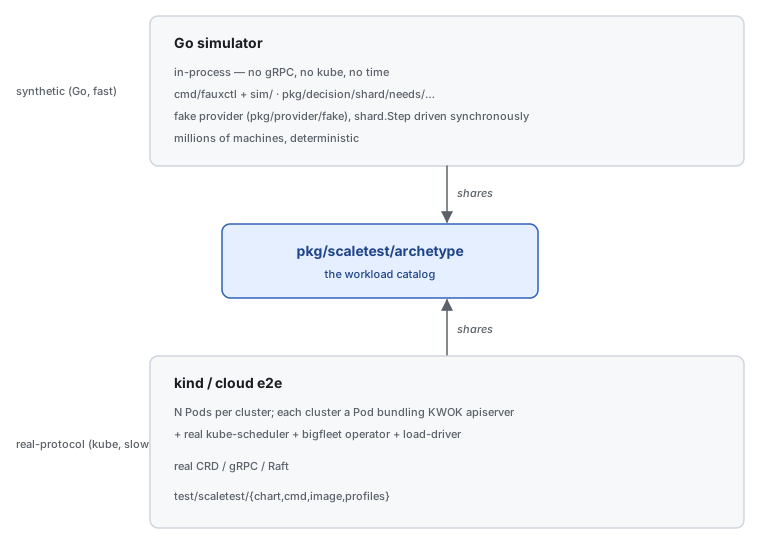
The split exists because the two layers catch different bug classes and cost different amounts:
- The synthetic layer runs the real engine (
pkg/decision,pkg/shard,pkg/needs,pkg/inventory) against an in-memorypkg/provider/fake, driven by directshard.Stepcalls — notime.Ticker, no goroutines beyondStep’s own, no gRPC. That makes it deterministic and fast: millions of machines and tens of thousands of cycles in seconds. It is where decision-engine logic bugs are cheap to find. - The real-protocol layer runs the real binaries over the real wire against real Kubernetes (KWOK-faked apiservers + a genuine
kube-scheduler). It is where harness wiring, substrate-scale, and protocol effects show up — chart drift, label validity, apiserver/etcd pressure, scheduler throughput. It is slow and (in the cloud) costs money.
The “E2E as we go / scale ceilings as we go” hard rule plus the ADR-0043 discipline produce the validation ladder (docs/scaletest.md §“The validation ladder”): cheap synthetic rungs gate first, the kind/dev-50 real-protocol rung runs devpod-side as step 0 of every cloud brief, and a cloud run is the last confirmation, never the discovery instrument. The rest of this document is the architecture of each rung.
Layer 1, the simulator: cmd/fauxctl + sim/
Fauxmaster lineage
cmd/fauxctl is modelled on Borg’s Fauxmaster (cmd/fauxctl/main.go:1): a CLI that drives the production decision/shard/inventory/needs packages against an in-memory provider so you can replay scenarios reproducibly. Its subcommands are deliberately small — list, run, run-all, record, verify — and they all route through sim.Run / scenario (cmd/fauxctl/main.go:36-66). The record/verify pair is the golden-trace mechanism: a scenario’s Trace is JSON-lines (one event per line, human-diffable — sim/runner.go:103-140), recorded under sim/golden/<name>.jsonl, and verify byte-compares the current run against it (cmd/fauxctl/main.go:188-225). A trace divergence is a behavioural regression in the engine, caught without any cluster.
Three simulation drivers, one engine
sim/ carries three increasingly-faithful drivers, all wrapping the same pkg/shard engine:
| Driver | File | What it models | Used by |
|---|---|---|---|
| Scripted scenario | sim/runner.go | A fixed timeline of rollups + assertions on end state | cmd/fauxctl, golden traces |
| Soak | sim/soak.go | Long synthetic churn; invariant assertions | make soak (nightly, soak tag) |
| Closed loop | sim/closedloop.go | A reactive workload model that owns Pods and reacts to BigFleet’s actions | make prevalidate rung 1 (go test -run ClosedLoop ./sim/...) |
Scripted scenarios (sim/runner.go)
A sim.Scenario (sim/runner.go:34-62) is a declarative struct: an initial fake-provider inventory (InitialIdle, InitialSpeculative — note Speculative is seeded, per ADR-0026, see below), an ordered Events timeline where each event applies one cluster’s full-replacement rollup via ApplyRollup and runs CyclesAfter cycles of shard.Step, and Assertions evaluated against final state. Run constructs a real shard.New with a fake.Provider{InstantTransitions: true} and a fixed seed (0xC0FFEE, sim/runner.go:168), so every run is reproducible. The registered scenarios (sim/scenario/) cover the engine’s interesting corners: capacity-stockout, priority-inversion, withdrawal, provider-configure-failure, drain-failure-withdrawal, training-job-topology — each a Factory registered by name (sim/scenario/scenario.go:14-25, init() calls in each file).
The scripted model has a structural blind spot, called out in code: demand never reacts to BigFleet’s actions (sim/closedloop.go:1-13). A fixed rollup timeline cannot exhibit the feedback loop Reclaim → drain → evict Pods → controllers recreate them → CR population churns → next rollup changes → Phase 1 reacts. That entire ADR-0038/0039/0040 bug class is invisible by construction in the scripted runner. The closed-loop driver exists to close it.
The closed-loop driver (sim/closedloop.go) — the demand half of the loop
This is the most important and most subtle piece of the simulator, and the workhorse of make prevalidate rung 1. RunClosedLoop (sim/closedloop.go:1088) runs the real shard engine against a reactive cluster model that owns Pods, derives each cycle’s rollup from its live Pods (mirroring pkg/operator buildRollup), binds Pods onto Configured machines, and evicts them when BigFleet drains a machine. The pathologies that historically cost 90-minute cloud runs to find become seconds-long go test failures.
Per cycle, in order (sim/closedloop.go:1189-1295):
- Age in-flight provision/bootstrap dwells (see below), apply any
TargetScale(thekubectl scaleanalogue) andFaultEvent(incumbent loss). - Each cluster derives its rollup from its live Pods (
clusterModel.rollup,sim/closedloop.go:647) and applies it viaApplyRollup. - One real
sh.Step(ctx)runs Phase 1/2/3 + OCC. - Machine-state changes are observed; affected Pods are evicted (
evictAndReconcile,sim/closedloop.go:676). - Controllers recreate evicted Pods; pending Pods bind (
clusterModel.bind,sim/closedloop.go:741).
The cluster model is a faithful, integer-math stand-in for the kube side. It mirrors the engine’s own tricks so its picture and the engine’s picture cannot drift:
- Rollup derivation mirrors the operator.
buildShapes(sim/closedloop.go:479) turns eachWorkloadShapeinto aneeds.Profileexactly as the UPC→operator chain does:Inrequirements from the nodeAffinity sets, aSamerequirement appended for gangs (sameRack/sameZone, mutually exclusive per ADR-0024), and penalties bucketed throughneeds.BucketForDollars(the operator is the canonical bucketing site). One CR = one Pod = one Need, grouped through the realneeds.Aggregate. - Binding mirrors kube-scheduler.
bindfilters by nodeAffinity, enforces gang Same-domain coherence (first member anchors the gang’s rack/zone, later members bind only there or stay pending — theplanGroupOntoRack“one rack or nowhere” rule), and among candidates picks the emptiest machine (vecSlots, least-allocated spreading —sim/closedloop.go:413). Capacity bookkeeping is interned milli-unit integer vectors (resVec,sim/closedloop.go:345), the sameocc.SameSupplyIndextrick the engine uses, so the per-cycle bind scan never parsesresource.Quantity. - Seeding mirrors
cmd/bigfleet seedFakeInventory.seedClosedLoop(sim/closedloop.go:944) mints the three tiers — Configured (running workloads), Idle (owned headroom, price 0), Speculative (elastic quota, priced) — with the same labels, zone/rack rotation, and contiguous-rack-block layout (ADR-0040 §4) the real seed uses.
Two booleans gate the bug classes the loop exists to pin:
ControllerManaged(sim/closedloop.go:174) — true: evicted Pods are recreated by their controller, demand is conserved, Phase 3 self-arrests at the true surplus. False: bare Pods, eviction destroys demand permanently — the ADR-0038 #45 unbounded supply-thrash cascade. The canaryTestClosedLoop_BarePodsDestroyDemand_Canarypins it.CRPerPod(sim/closedloop.go:180) — true: one CR per live Pod (papers §6.1, total demand). False: CRs only for pending Pods — the pre-ADR-0039 “unmet-only” signal that gave Phase 3 a phantom surplus. The canaryTestClosedLoop_UnmetOnlyCRs_PhantomSurplus_Canarypins it.
The loop also models engine latency it once could not, which matters because instant transitions froze the acquirable pool at equilibrium and hid oscillation drivers:
BootstrapDwellCycles(sim/closedloop.go:222) — a bootstrapped machine staysConfiguringfor N cycles before completing (ADR-0051 / M77g). Configuring is counted by the Phase 1 Same-domain coverage walk, so a machine in the bootstrap dwell is visible to its own gang and the dwell self-damps.ProvisionDwellCycles(sim/closedloop.go:248) — the pre-Configuring twin: a Provisioned machine staysCreatingfor N cycles (theSpeculative → Creating → Idlerunway). Creating is counted by neither the coverage walk nor the acquirable pool (foldAcquirablefolds only Idle+Speculative) and carries no AssignedGroup, so a machine in the provision dwell is invisible — the gang re-derives the full deficit and over-acquires. The extended doc comment atsim/closedloop.go:224-248is the load-bearing explanation; this is the runway the over-acquire diagnostic (#66) turns on.
The dwell is driven by holding the fake provider staged (ConfigureStaged/CreateStaged, sim/closedloop.go:1102) and a per-machine countdown the loop ages (completeMaturedCreateDwell — sim/closedloop.go:1394 — and completeMaturedDwell — sim/closedloop.go:1419). injectFaults (sim/closedloop.go:1455) uses RemoveMachine, not an in-place Configured→Failed, because the inventory FSM rejects the backward transition; a clean removal is the reconcile-ingestible incumbent-loss model.
Why the cardinality matters: TestClosedLoop_Uber5KCardinality (sim/closedloop_test.go:580) runs the closed loop at full uber-5k decision cardinality — 20 clusters × (2 plain classes + 95 memcache gangs + 32 GPU gangs) = 2,580 Needs total, 93% Same (sim/closedloop_test.go:568-579) — the convergence-failure class that historically cost a 90-minute cloud run apiece, now a go test.
Soak (sim/soak.go)
Soak drives the engine through many cycles (default 10,000, sim/soak.go:49) of synthetic churn — random per-cluster Replace rollups, periodic full withdrawals to exercise Phase 3’s reclaim path — and then asserts invariants, not behaviour: inventory size stays exactly IdleSeed + SpeculativeSeed (no leaked or phantom records, sim/soak.go:213), no machine ends in a transitional or Failed state (sim/soak.go:200-208), bounded wall-time and action volume. It is the repetition test for use-after-reclaim and leaked transitional records; nightly CI only (make soak, soak build tag).
The workload catalog: pkg/scaletest/archetype
This package is the one thing both layers share, by design (pkg/scaletest/archetype/archetype.go:1-17): the load-driver (which creates CRs/Pods) and the shard binary (which seeds Configured machines into the fake provider) read the same catalog, so demand and pre-bound inventory describe the same fleet. Drift between the two means Phase 3 reclaims the seed every cycle and the test measures reprovisioning, not steady state (realistic.yaml header, lines 59-63).
What an archetype is
An Archetype (pkg/scaletest/archetype/archetype.go:70) is one recurring production workload pattern — GPU training, GPU inference, CPU batch, CPU service, memory caches, stateful DBs, critical realtime — carrying a frequency Weight, acceptable instance types and zones, a resource shape, priority classes, and the two distinct penalties (InterruptionPenalty, ReclamationPenalty — never operational_value). The catalog top-level (Catalog, archetype.go:42) can optionally split SeedArchetypes from DemandArchetypes (M34, archetype.go:31), because real fleets drift: the seed reflects what’s been running, demand reflects what’s being submitted. Both fall back to Archetypes.
A Picker (archetype.go:293) draws archetypes weighted-random; per draw the archetype supplies a resource shape (PickSize over SizeBuckets), label values (PickLabels), a gang size (PickGroupSize), a replica count (PickReplicas, the heavy-tailed service-size distribution in sizing.go:37), and optionally a spread constraint (PickSpread).
The ADR layers that shaped it
The catalog is the most-iterated artefact in the harness because each cloud run that found a demand-shape error fed an ADR back into it:
- ADR-0015 (M33), realistic archetype improvements. Introduced
sizeBuckets(per-CR resource diversity → fingerprint multiplicity),meanLifetimeSeconds(bimodal lifetimes — immortal services vs short-lived batch),sameRack/groupSizeRange(Same-rack gangs — the protobuf-onlySameoperator, paper-load-bearing and previously untested under load). The header atrealistic.yaml:65-95is the running calibration log. - ADR-0032 (M44), production calibration. Re-shaped the catalog against industry patterns after a uber-5k run measured Phase 1 at ~5 minutes: the catalog was 99%
ModeAllOrNothingas an artefact, because most “sameRack” archetypes (DBs, caches) actually tolerate partial fills. Added the bottom-heavy long tail (tiny-stateless≈ 70% of pods), theallowPartialflag, three GPU-training gang tiers, topology spread, a realistic priority skew (~85% default), and ~30-60 fingerprints/cluster. All profiles now run Pod-mode + this 6-archetype-family catalog by default. - ADR-0037 (M35 revert), node-affinity dimensions are realistic. The earlier
labelAxesmechanism emitted syntheticteam/appaxes as required nodeAffinity, whichkube-scheduleralso uses to place Pods: bigfleet-uber #41 measured theNodeAffinityfilter rejecting 98.6% of placements and bind plateauing at 9.5%. The fix: node-affinity dimensions in the catalog must be things a real fleet pins Nodes on (instance type, zone), not Pod-level org labels.LabelAxis(archetype.go:177) survives as a mechanism but the realistic catalog drops the synthetic axes. - ADR-0038, controller-managed workloads. The catalog’s
IsStatefulset (sizing.go:54) classifiesstateful-db/memory-cacheas StatefulSets and everything else as Deployments — an intentionally small in-code set, not a profile knob (YAGNI). The replica distribution (replicaDistribution,sizing.go:37) andStatefulReplicaCap(sizing.go:47) also live in-code so demand generation and seed sizing agree onE[replicas]. - ADR-0050 (M78), machine-calibrated. The decisive realism correction, and the cleanest ADR-0043 case. The catalog was calibrated as a realistic pod-count distribution, but BigFleet allocates machines, and for a whole-machine GPU gang pod-share is machine-share (1 pod/node) while commodity pods pack ~100/node. That 100× spread means a realistic ~7% GPU pod share mechanically implies a ~90% GPU machine fleet, which no production fleet resembles. The fix is
PodsPerNode(archetype.go:99): a per-archetype node-packing density that supersedes M66.2’s “GPU = 1 always”. The realism catalog’s weights are now back-solved from a target machine mix (realistic.yaml:14-46), andTestRealisticCatalog_MachineMixpins the realized machine mix within tolerance.
Seed sizing — sizing.go, ADR-0044 / ADR-0050
sizing.go is the share math that keeps the shard’s seed and the runner’s effective-machine total from drifting. The key functions:
PodsPerMachine(sizing.go:167) —PodsPerNodewins outright when set (ADR-0050); else falls back to M66.2’s rule (globaldensityfor core-only/compressible shapes,1when any size bucket requests an extended resource, since device counts don’t scale with density).SeedScale(sizing.go:209) returns(factor, scaleExtended), wherescaleExtendedis true only when the archetype opted into ADR-0050 — that is what lets agpu:1inference Pod seed agpu:88-GPU node.MachineAllocation(sizing.go:263) — splits a machine total across archetypes by machine-demand share (largest-remainder, deterministic), then raises every gang archetype to at least its per-zonegangFloor(sizing.go:239, ADR-0044 §3 — without it the largest drawable gang is unsatisfiable by construction). The gang raises sit on top, so the result can exceedtotalMachines: intended, because a fleet that runs zone-scoped gangs needs the per-zone pool whatever the nominal total says.MachinesForPods(sizing.go:314) — the inverse: the effective machine total a pod target implies,Σ_a ceil(totalPods × podShare(a) / podsPerMachine(a)) + gang floors. This is why a profile with whole-machine archetypes reports an effective machine count well above its nominalscale.machines(dev-50’s “50 nominal ≈ 610 effective”, ADR-0044).scale.machines × densitystays the demand definition;MachinesForPodsis the supply the demand shape actually implies.
The profile preflight: pkg/scaletest/preflight (ladder rung 0.5)
preflight (pkg/scaletest/preflight/preflight.go:1-26) is static matching-capacity arithmetic over a profile — milliseconds, no Docker. It catches the seed-shape-vs-demand-shape mismatch that no soak duration can fix, before a ramp budget is burned. It was born from the 2026-06-11 dev-50 incident: the no-catalog legacy demand is single-shape (every Pod on one instance type) while the no-catalog seed rotates five instance types, so only ⅕ of the seeded pool could ever host demand — 4,800 matching Pod slots against a 4,950 bind gate, a stall knowable from the profile alone.
The package is also the single source of truth for the two shape tables that made the incident possible by living in two package mains where nothing could cross-check them: the no-catalog seed rotation (LegacyInstanceTypes, preflight.go:37, formerly cmd/bigfleet/shard.go) and the legacy demand shape (LegacyDemandResources, preflight.go:72, formerly the load-driver). cmd/bigfleet and the load-driver now both import them, so the check and the behaviour it models cannot drift.
LegacySeed.Check (preflight.go:118) computes MatchingSlots ((matchingFromRotation(machines) + matchingFromRotation(speculative) + configuredPerCluster × clusters) × density) and BindGate (99% of total target Pods) and fails — with a remediation suggestion — when matching capacity is provably below the gate. Scope honesty (preflight.go:20-25): it is a shortfall detector, not a green-guarantee. It models neither bind throughput, preemption, gang packing, nor spread; a profile can pass preflight and still fail for those reasons. It only proves the converse.
Critically, catalog-driven (V2) profiles are out of scope and skip the check (test/scaletest/cmd/scaletest-runner/preflight.go:38-52, :59-77): a catalog-driven seed draws machine shapes from the same catalog as its demand, so shape matching is by construction. The runner-side legacyPreflight wraps the package and refuses to install only an unreachable no-catalog profile. As docs/scaletest.md notes, the rung is empty of gated profiles since M77a and is slated for deletion with the legacy demand mode in M77b — its job is done once every profile is catalog-driven.
Layer 2, the real-protocol e2e: test/scaletest/
The runbook documents the operator surface (Helm chart, runner CLI, BYO substrates). Here is the component architecture.
One cluster = one Pod, bundling everything
Each simulated cluster is a single Kubernetes Pod that bundles its own KWOK-backed apiserver, a real kube-scheduler, the bigfleet operator, the node-creator, and the load-driver. clusterCount is derived from ceil(totalPods / podsPerCluster); host count and cost are derived from the substrate (ADR-0034). The chart lives at test/scaletest/chart/; the orchestrator is test/scaletest/cmd/scaletest-runner/main.go:1-25 — read profile, detect target from kubeconfig context, helm install, wait for steady state, soak, snapshot Prometheus TSDB, emit summary.json, helm uninstall (deferred, runs on Ctrl-C).
BYO substrate — ADR-0034
The defining structural decision of the e2e layer: a run is profile × substrate, two orthogonal YAMLs (runner main.go:124-130). The profile (test/scaletest/profiles/<scale>.yaml) is the substrate-agnostic test definition — scale, density, catalog, ramp, soak, churn. The substrate (test/scaletest/substrates/<shape>.yaml) is the user-supplied runtime — per-host capacity, per-cluster apiserver operating point, kwok-pod resources, storage backend, cost. The runner merges them into Helm values and derives geometry. This is why profile filenames are 5k/50k/1m (scale only) and not scaleway-50k/uber-50k (the old bundled shape ADR-0034 unbundled); see the memory note on the devpod-→uber- rename for the public-vs-internal profile distinction.
Real kube-scheduler in the harness — ADR-0023
The harness originally shipped pod-shim (test/scaletest/cmd/pod-shim/), which did three jobs inside each cluster: create fake Nodes from UpcomingNode CRs, mark Pods Unschedulable, and bind Pods. Jobs 2 and 3 are kube-scheduler’s job in production, and faking them made the harness’s own scheduler the dominant variable in the published numbers — a 2026-05-13 uber-5k run measured 102 s p99 binding latency entirely on pod-shim’s bind path, while BigFleet itself sat well inside SLO. ADR-0023 replaced jobs 2/3 with a real kube-scheduler per cluster (configured with NodeResourcesFit / MostAllocated to bin-pack to the ADR-0022 density model rather than spread), and kept only job 1 as a new ~100-line binary, node-creator (test/scaletest/cmd/node-creator/main.go:1-17): watch UpcomingNode, create fake Nodes, nothing else. The chain is now the real production shape:
Pod → kube-scheduler marks Unschedulable → unschedulable-pod-controller → CapacityRequest → operator roll-up → shard NeedsTable → Phase 1/2/3 → provider → Bootstrap → UpcomingNode → node-creator → fake Node → kube-scheduler binds the PodThis is exactly what the dev-50 gate proves wires up end to end (dev-50.yaml:18-29).
Controller-managed workloads — ADR-0038
The load-driver (test/scaletest/cmd/load-driver/main.go:1-32) creates Deployments / StatefulSets, not bare Pods. A bare Pod, once evicted by a Phase 3 drain, is gone forever — which made every reclaim permanently destroy demand and produced the unbounded ~26-machines/sec Bootstrap+Reclaim cascade of bigfleet-uber #45. Controller-managed Pods are recreated by their controller after eviction, so demand is conserved and Phase 3 self-arrests at the true surplus. This is the same conservation law the closed-loop sim’s ControllerManaged flag models; the harness and the sim test the same property at different fidelities.
The Speculative tier must be modelled — ADR-0026
A long-latent bug: seedFakeInventory originally seeded only Idle + Configured and never called AddSpeculative, so Phase 1’s Speculative fallback (Create + bootstrap — the paper’s entire elastic-procurement story, bigfleet.md §5/§8) was dead code in every scaletest. Any demand the fixed Idle pool couldn’t directly satisfy became a permanent shortfall, which is not how BigFleet behaves. ADR-0026 made the harness seed both tiers, with a non-zero --seed-speculative default — there is no “fixed-pool-only” regime because the paper has no such regime. The simulator already did this (InitialSpeculative in sim/runner.go:48, SpeculativeSeed in sim/soak.go); the e2e harness was brought into line.
Demand regimes and SLOs
Regime-parametric cycle p99 — ADR-0013 / ADR-0028
The cycle-p99 bar is not a single number; it is parametric in the demand-to-inventory ratio (ADR-0013), because real fleets (Borg, Twine) live at ~1-2% pending demand in steady state, ~5-10% during ramps, and only hit 1:1 during operational events (cluster migration, DR, mass eviction):
| Regime | Pending demand vs inventory | SLO |
|---|---|---|
| Steady state | ≤ 2% (1:50) | cycle p99 ≤ 50 ms |
| Burst (deploy ramp, AZ rebalance) | ≤ 10% (1:10) | cycle p99 ≤ 100 ms |
| Reprovisioning (migration, DR, mass eviction) | up to 100% (1:1) | no per-cycle SLO; convergence-rate guarantee instead (≥5,000 bindings/cycle until drained) |
Steady-state and burst are the production guarantees; release-blocking profiles run at the burst ratio, the worst case the production SLO must honour. ADR-0028 adds that the realistic catalog’s cycle cost scales with Need cardinality (the sameRack gangs produce per-group Needs — ~388 Needs/cluster, not the ~8 the aggregated regime suggests), which is why the bench gate (make bench-hot) measures Phase 1/3 at measured uber-5k cardinality (~2,600 Needs, 93% co-located, 25K-CR rollups) rather than the naive aggregate.
Steady-state SLOs under churn — ADR-0035
ADR-0035 is the methodology decision that reframed the gate. The harness used to gate on ramp behaviour (bind ~100% of N within a budget), which conflated two things: capacity/ramp (how fast the system fills, dominated by downstream kube-scheduler/kine/kubelet behaviour) and the steady-state SLO (per-CR binding latency under churn — what the docs actually promise). A long investigation converged on the ramp ceiling being a kube-scheduler property under high label cardinality, not a BigFleet property — the steady-state SLOs were never failing.
The fix: pre-seed to steady state at install (seed.preBind: true + configuredFraction: 1.0, the load-driver sets Spec.NodeName at create time — no scheduler walk, no ramp) and measure SLO histograms over a soak window driven by continuous churn (churnPerMinute, each replacement Pod’s CR-creation-to-bound latency is the sample). Ramp time/throughput stay captured but stop gating. The M77a/ADR-0045 refinement on V2 profiles: BigFleet’s contract is demand covered by bound capacity — it does not promise pod placement — so waitForSteadyStateV2 gates on shard_shortfalls == 0 with demand at target and acquisitions quiescent, not on a bind percentage; pod-bind progress is reported but never gated (satisfied-but-stuck is the cluster’s problem).
The bounded-reclaim gate (ADR-0035 amendment) is the most recent tuning: Phase 3 is shrinkage-only and should be inert at steady demand, but zero reclaims is unachievable on the async engine (ADR-0021) whose endogenous async-actuation reclaim floor is proven coverage-harmless (bigfleet-uber #65-69). So the gate snapshots the reclaim baseline settleSeconds into the soak (de-tailing the post-fill settling transient) and bounds the count by slo.maxReclaimActionsDuringSoak (dev-50: 150, an author-owned posture number, ~2-3× the de-tailed rate, far below a regression — dev-50.yaml:110-125). A regression (the M67 bootstrap≈reclaim oscillation resurfacing as sustained churn) still trips it.
The dev-50 gate, concretely
dev-50.yaml is the per-milestone laptop integration gate. It is a correctness gate, not a scale test and not a realism instrument (dev-50.yaml:48-50) — no measurement taken there feeds a mechanism decision; that is the cloud profiles’ job on realistic.yaml, per ADR-0043. It runs the realistic-dev coverage catalog (realistic-dev.yaml:1-24): same archetype names and shapes as realistic.yaml (so name-keyed logic — isStateful, gang anchoring — behaves identically), but gang sizes proportionate to a 50-machine fleet (gpu-training-large is omitted — its 64-256-machine gang cannot exist in dev-50’s supply) and weights flattened so every demand path is exercised every run rather than probabilistically. Its job is to prove the chain wires up and the catalog demand paths (archetype draws, ADR-0041 sub-machine folding, Same(rack)/Same(zone) gangs, anchoring) work at gate speed.
The validation ladder in code
The ladder (docs/scaletest.md §“The validation ladder”, Makefile:109-129) is the operational expression of “cloud-last”:
| Rung | Command | What runs | Catches |
|---|---|---|---|
| 0.5 | prevalidate step 1 | TestCommittedProfiles_MatchingCapacityPreflight (in test/scaletest/cmd/scaletest-runner/, driving pkg/scaletest/preflight) | seed/demand arithmetic on legacy profiles |
| 1 | prevalidate step 2 | go test -run ClosedLoop ./sim/... (incl. TestClosedLoop_Uber5KCardinality) | decision-engine feedback bugs |
| 2 | prevalidate step 3 → bench-hot | Phase 1/3 + rollup benches at uber-5k cardinality | per-cycle cost regressions |
| 3 | prevalidate-kind / devpod brief step 0 | dev-50 (V2 catalog) + example-kind-laptop, real binaries on kind | harness wiring; the ADR-0045 contract |
| 4 | a scale profile on a real substrate | full real-protocol run | substrate-scale effects only |
make prevalidate is rungs 0.5-2, Docker-free, ~3 min; every SHA bound for a cloud brief passes it before the brief is filed. Rung 3 runs devpod-side as step 0 of every cloud brief and fail-fasts the brief (verdict + gate log, no cloud profile spent) if it cannot go green — it lives where the compute is free and the images get built anyway. make prevalidate-kind keeps it runnable locally for working on the harness itself, but the standing guidance is not to run the kind rung on the laptop as a routine gate — it burns the dev box for work the devpods do free. A cloud failure a lower rung would have caught is a process bug, not just a code bug.
The synthetic scale-ceiling tests (make scale, the scale build tag — test/scale/*.go, Makefile:96-98) are a distinct axis from the ladder: they exercise the engine at millions of machines / thousands of streams on the M5 Max budget, and the achieved numbers become each milestone’s baseline (plan §5.1). The kind/cloud e2e runs the same scenarios at realistic-but-smaller scale through real binaries.
Map: where each concern lives
| Concern | Code | Authority |
|---|---|---|
| Fauxmaster CLI, golden traces | cmd/fauxctl/main.go | — |
| Scripted scenarios | sim/runner.go, sim/scenario/ | — |
| Reactive closed loop (feedback bugs) | sim/closedloop.go | ADR-0038/0039/0040/0045/0051 |
| Long-run invariant soak | sim/soak.go | — |
| Workload catalog (shared) | pkg/scaletest/archetype/archetype.go | ADR-0015/0032/0037 |
| Seed/machine share math | pkg/scaletest/archetype/sizing.go | ADR-0044/0050 |
| Profile preflight (rung 0.5) | pkg/scaletest/preflight/preflight.go | M60 |
| e2e orchestrator | test/scaletest/cmd/scaletest-runner/main.go | ADR-0034/0035 |
| Load-driver (controller-managed demand) | test/scaletest/cmd/load-driver/main.go | ADR-0038 |
| Node-creator (UpcomingNode → fake Node) | test/scaletest/cmd/node-creator/main.go | ADR-0023 |
| Synthetic scale ceilings | test/scale/*.go (scale tag) | plan §5.1 |
When in doubt about why a piece of the harness is shaped the way it is, the answer is almost always a cloud run that found a demand-shape error and an ADR that corrected the harness rather than building engine mechanism against the artefact (ADR-0043). The ADR-0042 parking layer — rigorous mechanism built against one catalog archetype (gpu-training-large) demanding physically impossible rack-coherent gangs — is the cautionary tale the whole discipline exists to prevent.